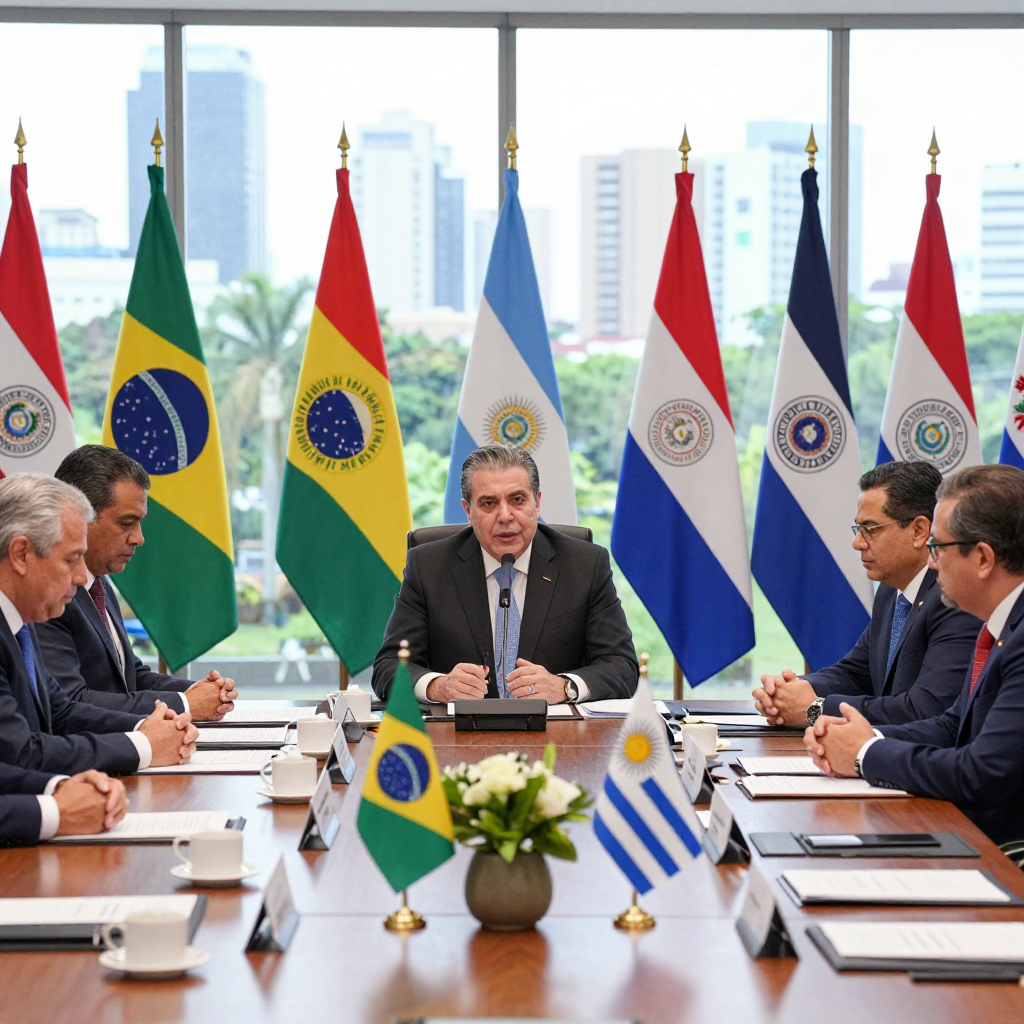
Asunción, Paraguay – Amid global shifts in trade dynamics and evolving geopolitical landscapes, Paraguay is strategically positioning itself to leverage its membership in Mercosul (Mercado Común del Sur) for enhanced trade opportunities. Government officials have indicated that the nation is focusing on strengthening both intra-Mercosul and external alliances to bolster its economic standing and competitive edge.
Mercosul, which includes Brazil, Argentina, Uruguay, and Paraguay as full members, has been instrumental in shaping Paraguay’s trade policy. However, recent challenges, such as economic instability in some Mercosul countries and evolving trade agreements elsewhere, have prompted Paraguay to explore broader collaborations. Analysts suggest that Paraguay could benefit from diversifying its trade relationships while maintaining its core commitment to Mercosul integration.
Paraguay’s economy heavily relies on agricultural exports, particularly soybeans, cotton, and livestock products. As the country seeks to expand its market reach, it is engaging proactively with neighboring countries and global partners who share mutual interests in sustainable trade practices. In May, Paraguayan President Mario Abdo Benítez emphasized at a regional summit in Asunción that the nation is committed to fostering open dialogue and cooperation to address shared economic challenges.
One key focus area for Paraguay is digital innovation and supply chain resilience. The country is investing in infrastructure projects aimed at modernizing logistics and enhancing connectivity, which could attract foreign investment in sectors beyond agriculture. Additionally, Paraguay is exploring frameworks for establishing free trade agreements (FTAs) with non-Mercosul nations, potentially including countries in Asia and Europe, to tap into new markets.
Diplomatic efforts are also underway to enhance Paraguay’s influence within Mercosul. The country has been advocating for greater inclusivity in decision-making processes and more equitable resource distribution among member states. By doing so, Paraguay aims to ensure that its unique economic strengths—such as its strategic geographic position linking South America to the Atlantic—are recognized and leveraged to the fullest extent.
While analysts remain cautiously optimistic about Paraguay’s prospects, they caution that success will depend on overcoming internal regulatory hurdles and ensuring sustained political support for reform initiatives. The national government has signaled its intention to streamline policies related to foreign direct investment and intellectual property protection, signaling a clear commitment to creating a more business-friendly environment.
In conclusion, Paraguay’s pursuit of strategic alliances, both within Mercosul and internationally, reflects its ambition to solidify its role as a key player in regional and global trade networks. By balancing its commitments to Mercosul with broader diplomatic engagements, Paraguay is poised to capitalize on emerging opportunities while mitigating potential risks in an increasingly interconnected world.