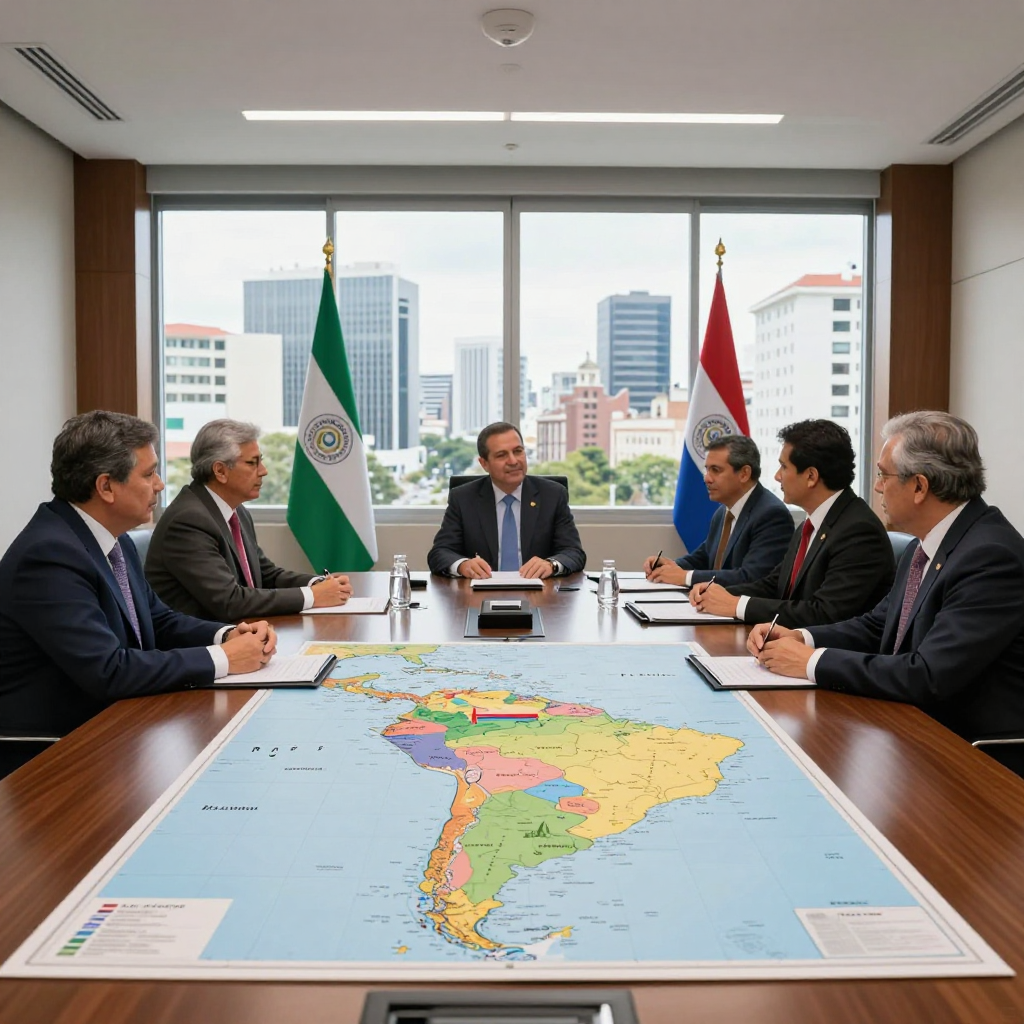
Asunción, May 18 — In a move aimed at bolstering its position within the Mercosur trade bloc, Paraguay is intensifying efforts to secure enhanced trade agreements that could drive national economic growth and cement its role in the wider global market. At a time when Mercosur countries are exploring new avenues for collaboration beyond their traditional partners, Paraguay’s proactive stance reflects its ambition to play a more prominent role in international commerce.
Mercosur, comprising Argentina, Brazil, Paraguay, Uruguay, and associate members including Chile, Bolivia, and Peru, has long been a cornerstone of South America's regional integration efforts. However, recent discussions within the bloc have highlighted the need to diversify trade relationships to counterbalance dependencies and boost competitiveness. This shift comes as Mercosur nations increasingly look toward Asia-Pacific markets, particularly China and India, for expanded trade opportunities.
For Paraguay, a landlocked country with a population of approximately 7 million, enhancing trade ties is crucial for economic development. The nation relies heavily on agriculture, including soybean and cotton exports, which constitute a significant portion of its GDP. Yet, limited infrastructure and geographical constraints pose challenges to Paraguay's ability to expand its export base. To address these issues, the government has initiated several initiatives to improve logistics and attract foreign direct investment (FDI).
Speaking at a recent Mercosur summit, Paraguayan Foreign Minister Sandra Quiñónez emphasized the country's commitment to strengthening its trade relations. “We are actively engaging with potential partners to explore new markets that align with our production capabilities,” she said. While具体合作细节尚未确定,分析人士建议Paraguay专注于与亚洲国家建立贸易走廊,利用其农产品优势和邻国的出口基础设施。
In addition to traditional agricultural exports, Paraguay is also positioning itself as a hub for renewable energy investments. Recent developments in hydraulic power generation along the Paraná River have attracted interest from international investors, offering opportunities for sustainable energy projects that could further diversify the country's export profile. This focus on green energy aligns with global trends and could enhance Paraguay's appeal to environmentally conscious markets.
Analysts suggest that Paraguay's engagement with Mercosur’s broader trade strategies may lead to increased participation in free trade agreements (FTAs). Mercosur has been negotiating such deals with partners like the European Union and Canada, and Paraguay's active involvement could open doors to new export opportunities. However, challenges remain, including bureaucratic hurdles and uneven political priorities across Mercosur member states.
Despite these challenges, Paraguay's proactive approach underscores its determination to capitalize on regional and global economic shifts. By leveraging its natural resources and strategic location within Mercosur, Paraguay aims to position itself as a key player in upcoming trade transformations, benefiting both its domestic economy and the broader Mercosur community.